CM Incentive Limits: $750 SAMHSA Cap Meets New $2,000 1099 Threshold
For years, Contingency Management (CM) program leaders have been stuck between two very different realities:
-
What the evidence supports for motivating recovery behavior?
-
What administration and tax-reporting friction made practical in the real world?
That gap is narrowing, fast, and it’s great news for expanding CM at exactly the moment the country needs more effective tools to address stimulant and polysubstance use.
SAMHSA’s message is clear: CM works—and up to $750 per person per year is allowable under eligible grants
In January 2025, SAMHSA released an advisory on using SAMHSA funds to implement evidence-based CM services. SAMHSA describes CM as a proven health care intervention with demonstrated effectiveness across substance use disorders, and highlights that it is particularly effective for stimulant use disorders—noting the lack of FDA-approved medications and describing CM as a primary and potentially life-saving intervention. SAMHSA Library
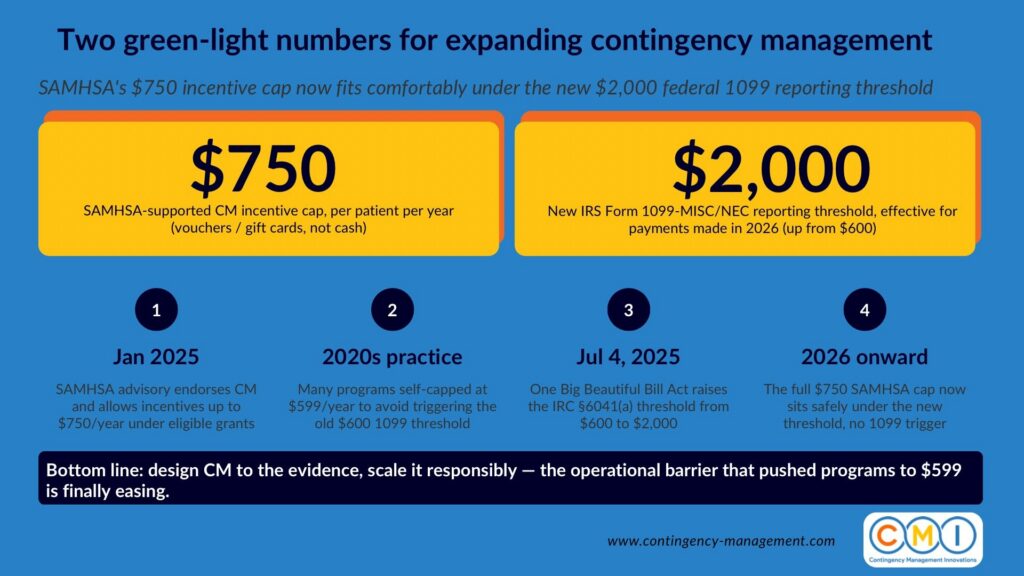
Crucially, SAMHSA states that eligible recipients of SAMHSA grants that authorize CM activities may provide motivational incentives up to $750 per patient, per year, subject to safeguards and program integrity guardrails. SAMHSA also emphasizes that incentives should be items, vouchers, or gift cards supporting recovery and well-being—cash payments are not permitted under this guidance. SAMHSA Library
In short: SAMHSA’s updated stance supports implementing CM in a way that aligns with the research—while still keeping the right guardrails in place. SAMHSA Library
Why so many programs historically “stopped at $599”
Even as CM gained momentum, many real-world programs constrained their annual incentive maximums to $599—not because the science demanded it, but because a $600+ annual payment can trigger Form 1099 reporting requirements in many scenarios.
You can see this pattern reflected in publicly posted CM program designs, including programs that explicitly cap the incentive amount at $599 per calendar year. Los Angeles County Public Health+2Penn LDI+2
The result: a lot of CM programs have been forced into a “just under $600” design—often leaving outcomes (and engagement) on the table.
The new federal change: the 1099 reporting threshold rises to $2,000 (starting in 2026)
Now for the game-changer.
A federal law enacted July 4, 2025 (P.L. 119-21, commonly referred to as the “One Big Beautiful Bill Act”) updated Internal Revenue Code §6041(a) by replacing the $600 threshold with $2,000 for information reporting—effective for calendar years beginning after December 31, 2025 (i.e., payments made in 2026 and beyond). Congress.gov+1
The IRS has also reflected this change in its draft Publication 1099 (2026) materials, noting the threshold increase to $2,000 (and that it will be inflation-adjusted beginning in 2027). IRS
What this means for CM expansion: SAMHSA’s $750 fits comfortably under the new $2,000 threshold?
Put the two updates together:
- SAMHSA supports CM incentives up to $750 per patient per year under eligible grant programs (with safeguards). SAMHSA Library
- The federal information-reporting threshold that many programs designed around has now increased to $2,000 starting in 2026. Congress.gov+1
That means a CM program can more easily implement the full SAMHSA-supported incentive level without automatically crossing the federal 1099 reporting line that shaped so many “$599 max” designs.
This isn’t just a paperwork improvement. It removes a quiet but meaningful barrier to evidence-based care:
- fewer administrative hurdles for providers,
- less stigma and confusion for participants,
- and more flexibility to design CM schedules that match the evidence (frequency, immediacy, escalation).
A quick, important tax note (so nobody over-promises)
Raising the reporting threshold generally reduces when a payer must issue a 1099—but it does not determine whether something is taxable income for the recipient. Programs should still work with finance/tax counsel on proper treatment of incentives, documentation, participant communications, and any state-specific requirements.
Bottom line: this is a rare alignment of policy and practicality
CM has always been one of the most effective behavioral interventions in addiction care—especially for stimulant use disorder. SAMHSA’s guidance in January 2025 endorsed a realistic, evidence-aligned incentive ceiling of $750 with clear guardrails. SAMHSA Library
Now, with the 1099 reporting threshold moving to $2,000 starting in 2026, a long-standing operational constraint that pushed many programs to $599 is finally easing. Congress.gov+2Los Angeles County Public Health+2
For CM leaders, Medicaid agencies, SUD providers, and policymakers, this is a practical “green light” moment: design CM to what works, scale it responsibly, and reach more people with an intervention that measurably improves engagement and outcomes.
For additional information contact:
Larry Klimczyk
Chief Commercial Officer
www.contingency-management.com
Book an appointment to learn more about Contingency Management, click here.