Contingency Management vs. Incentives: What’s the Difference?
Rewards are everywhere in behavioral health. Gift cards for showing up, a prize for a milestone, a small bonus for staying engaged. It’s easy to assume that any program offering a reward is doing Contingency Management (CM). It isn’t, and the difference matters for the people you serve and for the results you can expect.
A new infographic from the Addiction Technology Transfer Center (ATTC) Network, published in October 2026, lays the distinction out clearly. It was built on the expert consensus of the ATTC POWER Team on Contingency Management and Stimulants. Here is what it says, and why it matters for your program.
The Short Version
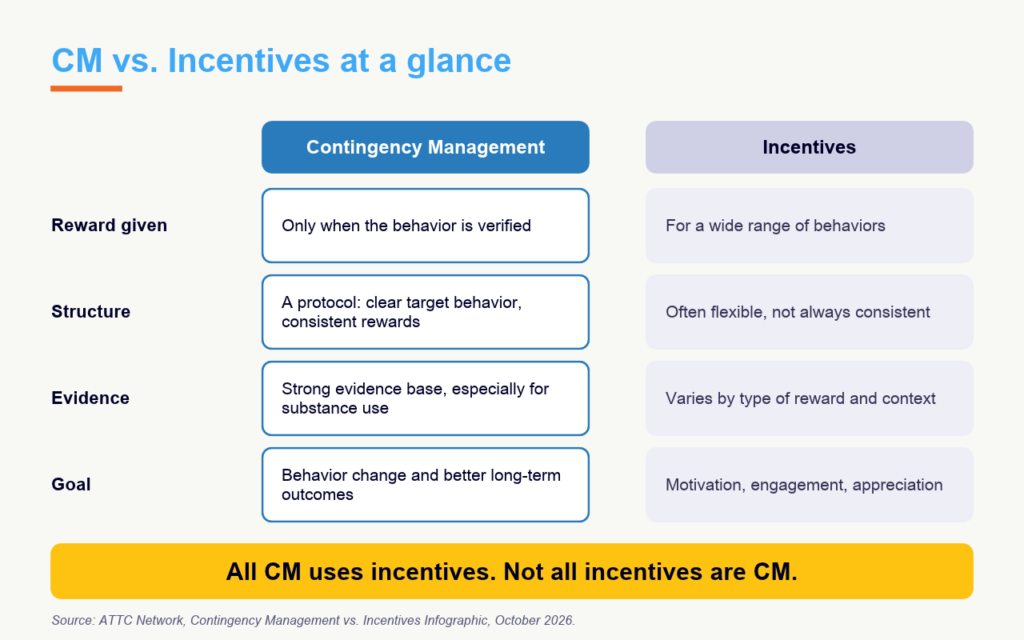
Every Contingency Management program uses incentives, but not every incentive is Contingency Management. “Incentive” is a general word for any reward offered to encourage or recognize a behavior. CM is something more specific: a structured, evidence-based intervention that delivers a tangible reward only when there is verified evidence that a specific behavior happened.
Six Ways They Differ
Summarized from the ATTC Network infographic.
Definition. CM is a systematic intervention built around verification. An incentive is any reward or benefit offered to encourage or recognize behavior, with or without a system behind it.
Focus. CM targets specific, measurable behaviors, such as a negative drug test. Incentives can aim at a much wider range of behaviors and outcomes.
Structure. CM follows a protocol: a clear target behavior, consistent rewards, and set consequences. Incentives tend to be more flexible and may not be delivered consistently or tied to a specific, verified action.
Evidence. CM has a strong evidence base, especially for substance use and treatment adherence. For incentives in general, effectiveness varies widely depending on the type of reward and the context.
Examples. CM looks like vouchers for negative drug screens, prize draws for treatment milestones, or earnings-based rewards. Incentives look like gift cards, cash bonuses, extra time off, recognition awards, or free merchandise.
Goal. CM aims at behavior change and better long-term outcomes. Incentives aim more broadly at motivation, engagement, appreciation, or performance.
Why the Distinction Matters
If a program hands out rewards without verification, consistency, or a clear target behavior, it’s offering incentives, and it may not see the results that research on CM describes. The structure is what turns a reward into a treatment. That is also why programs that are designing a CM service, or applying for funding to start one, benefit from being clear about which one they mean.
The structure is also the hard part to run day to day. Verifying the behavior, tracking it, and delivering the reward quickly and consistently takes work for any care team. That’s where CMI’s platform comes in: it handles the testing, tracking, and reward delivery, so clinicians can spend more of their time with the people they serve.
What to Ask Before You Start
If you’re building or evaluating a program, a few questions help separate Contingency Management from a general incentive:
Is there a specific, measurable behavior being reinforced?
Is that behavior verified before the reward is given?
Are rewards delivered consistently and soon after the behavior?
Is there a clear protocol for the care team to follow?
If the answer to each is yes, you are doing CM. If not, you may be offering incentives, which can still be valuable, but they are a different thing.
If you want to talk through how Contingency Management could fit in your program, we’d be glad to help.
For additional information contact:
Larry Klimczyk
Chief Commercial Officer
www.contingency-management.com
Book an appointment to learn more about Contingency Management, click here.